
The appointment of judges to Venezuela’s transitional Supreme Court (TSJ) has entered its decisive stage. To put it in Star Wars terms, some of the nominees are already acting like Emperor Palpatine behind closed doors, convinced their credentials guarantee them a seat. Yet citizens can still answer them like Mace Windu, Jedi Master and martyr of the resistance:
Filing a formal challenge (impugnación) is the only tool that does not depend on the National Assembly, the Negotiating Table led by Dinorah Figuera and Jorge Rodríguez, or its overseers in Washington. Right now, it depends on us as citizens.
For more than two decades, the TSJ has been the piece that made the dismantling of the rule of law “legally” possible. From that bench, the democratically elected 2015 National Assembly was stripped of its powers, political parties were taken over, candidate disqualifications were upheld, and political persecution was given legal formality. For these reasons, the renewal of the court cannot be viewed as a mere administrative step. It is one of the most consequential institutional decisions of the transition.
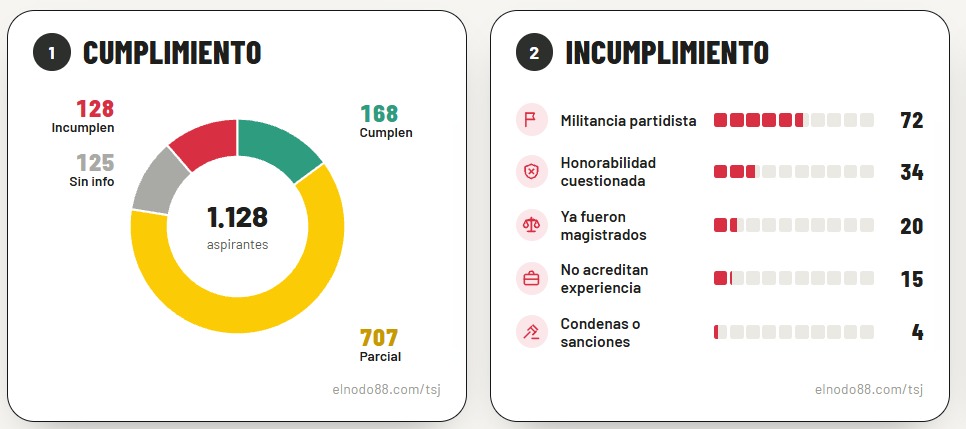
We found that out of 1,066 applicants for Supreme Court seats, only 159 prove with public information that they meet all eight constitutional requirements.
The new TSJ will be tasked with transforming the judiciary, meaning those who sit on this court will decide how laws are enforced, what rules will govern upcoming elections, how legal proceedings advance for those still unjustly imprisoned, and what reparations will look like for victims of human rights abuses. In other words, this new TSJ will hold the reins of the country’s justice system for the next twelve years.
The process is now at a rather delicate point. After a brief extension, the Judicial Nominations Committee (CPJ) closed applications on November 18 with 1,343 submissions for the 32 principal TSJ posts, the General Inspectorate of Courts, and the Directorate of the National School of the Magistracy. For the first time since chavismo took power, the CPJ has opened a window for citizens to participate in the judicial selection process.
Where do we stand?
Following the agreements of the Negotiating Table installed on August 6, the National Assembly amended Article 65 of the Organic Law of the TSJ so that a majority of the Committee’s members are civil society representatives. This makeup comes closer to what Article 270 of the Constitution requires, even though the chair remains in the hands of a ruling-party lawmaker (chavista admiral Giuseppe Alessandrello) and the civil representatives were preselected by lawmakers themselves.
Still, credit must be given for what has changed. On November 2, the Committee published the scoring rubric (baremo) it will use to evaluate applicants (something that didn’t happen in previous renewals) and it has announced each stage of the schedule along the way. On November 21, the Committee opened the window to receive public challenges through December 5. What does this mean? Every citizen has the opportunity to submit evidence against nominees who fail to meet the requirements to serve as a justice.
Once the challenge window closes, the Committee has eight days to rule on the objections and, where applicable, summon contested applicants to a hearing to defend themselves. Out of that step comes a first shortlist sent to the Citizen Power branch—chaired by Larry Devoe—which will draw up a second shortlist before the National Assembly elects the judges in a plenary session.
The only moment in the process where citizens can intervene directly is through these challenges. That is why knowing who the applicants are is vital—to determine who would make the best judges for a transition, rather than a transaction, as Guillermo Tell Aveledo, dean at UNIMET and a member of the CPJ, has put it.
What the numbers say
The Committee made the list of applicants public, and for the first time, organized public information exists on each one. The platform tsj.macedoniadelnorte.com compiled the nominees’ profiles, a project led by digital activist and software engineer Giuseppe Gangi, who was part of the movement to reject the CNE’s results following the 2024 electoral fraud.
At Nodo 88, a political data analysis platform, we vetted all 1,128 applicants one by one against the eight requirements set out in Articles 263 and 264 of the Constitution and Article 37 of the Organic Law of the TSJ: (1) Venezuelan nationality by birth and holding no other nationality, (2) recognized honorability, (3) competence as a jurist, (4) fifteen years of accredited experience, (5) no criminal convictions or sanctions, (6) no partisan affiliation, (7) no familial ties to high-ranking officials, and (8) not having previously served as a Supreme Court judges, as the Constitution establishes a single 12-year term.
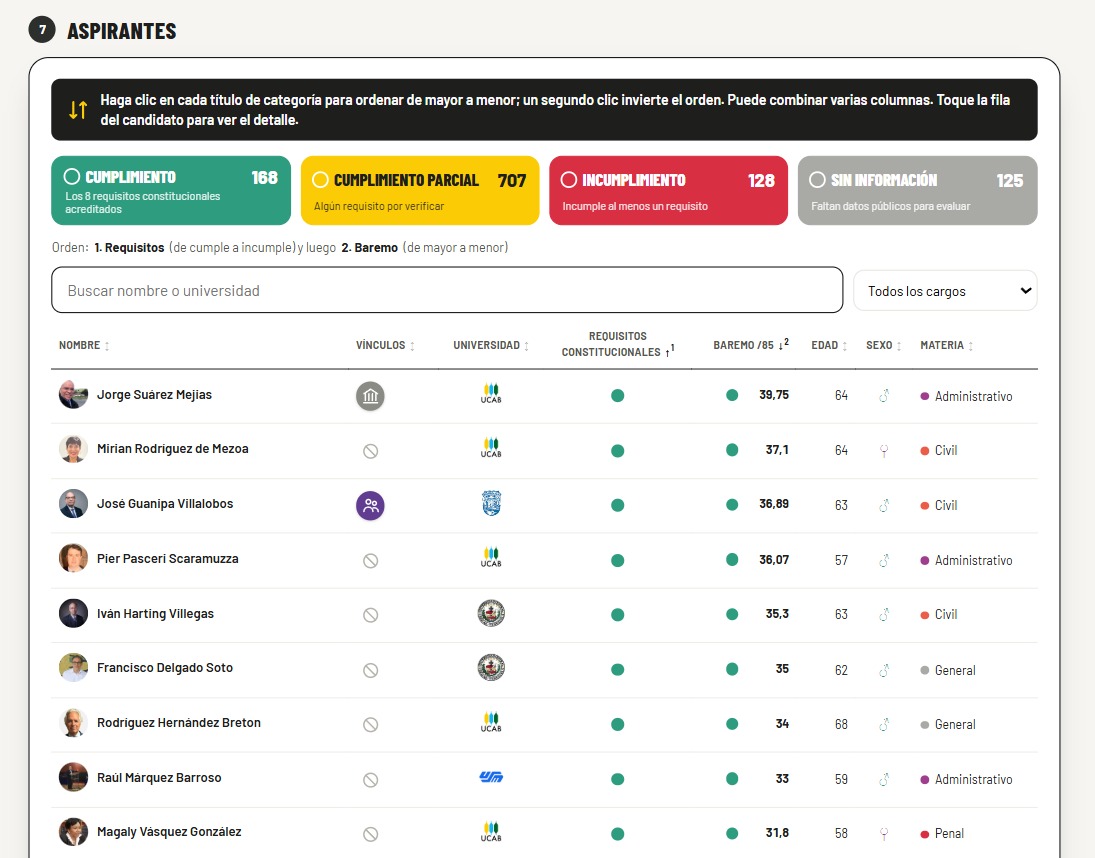
Our standard is deliberately strict. Failing to meet a single requirement disqualifies a nominee, and a single unverifiable data point prevents us from confirming that they qualify. This is not methodological arbitrariness: the Constitution itself requires all criteria to be met concurrently, and the burden of proof lies with the applicant, not the observer. That is why we also invite the nominees themselves to review their files and supply any missing information.
The country has jurists who meet the requirements established by the Constitution. The problem has never been a lack of candidates, but the will to choose them.
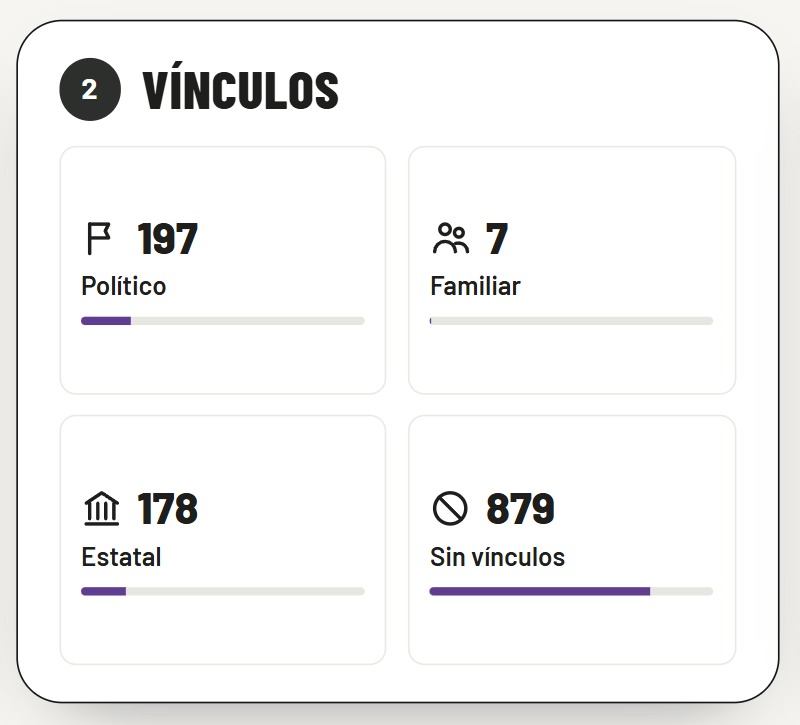
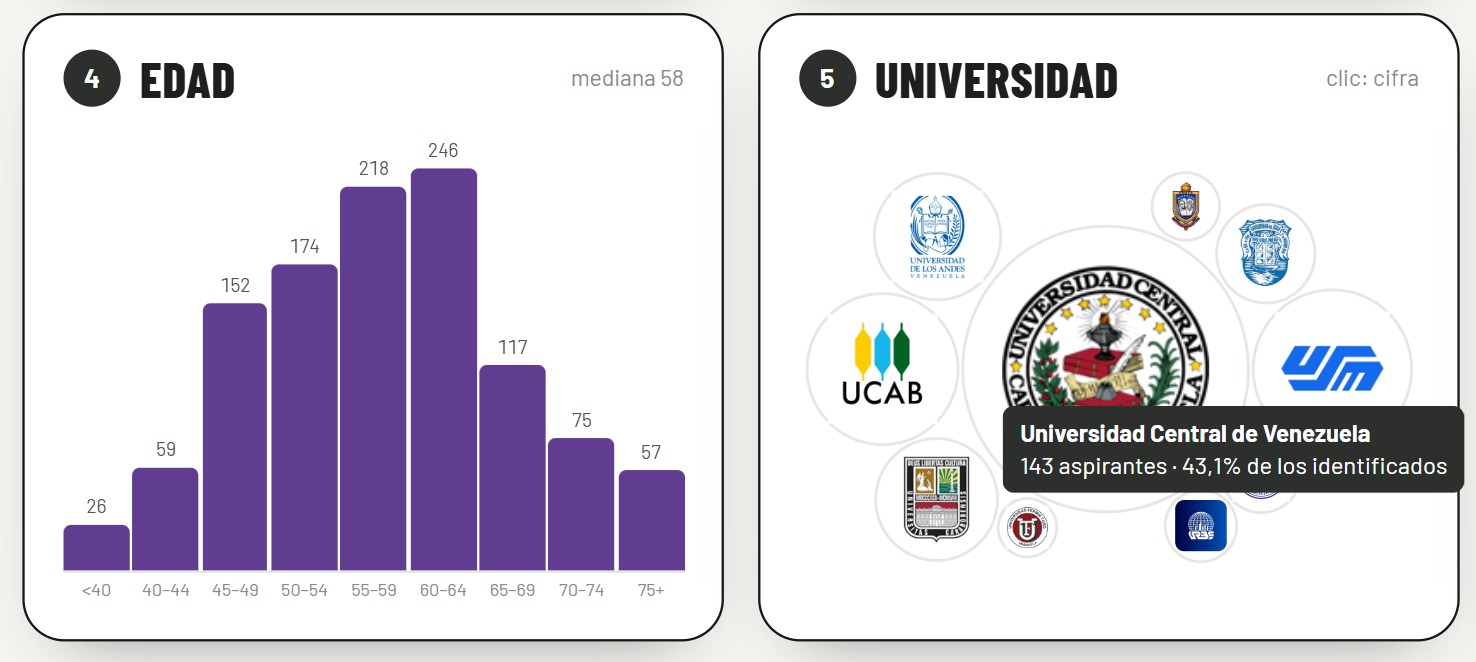
We found that out of 1,066 applicants for Supreme Court justice, only 159 prove with public information that they meet all eight requirements. Another 673 have at least one requirement pending verification (primarily professional experience), and 116 clearly fail at least one criterion. Most of those who fail have partisan affiliations or previously served as justices, and 30 face serious questions regarding their honorability. Although family ties or prior state positions are not strictly disqualifying factors, one in five applicants has them on record.
These numbers can be viewed from two angles. The first is disconcerting: the applicant pool is inflated with profiles that should not advance to the next round. The second is hopeful: within that pool, there is a sizable group of candidates who do meet constitutional standards—enough to fill the court’s six chambers several times over.
The country has jurists who meet the requirements established by the Constitution. The problem has never been a lack of candidates, but the will to choose them.
From proof to action
Article 264 of the Constitution establishes the challenge mechanism as a tool of citizen oversight—meaning you do not need a lawyer or a political party to file one.
What should I bring? All a citizen needs to file a challenge is their national ID card (cédula de identidad), a written brief identifying the applicant, explaining which requirement they fail to meet, and attaching supporting evidence. Bring an extra copy of everything so the committee stamps it as received—because, as the saying goes, “paperwork beats votes.” And do not send it with a courier; you must appear in person to file it.
When and where? Challenges are being received at the National Assembly’s Museo Boliviano in Caracas, where the CPJ has been operating since its installation last month.
Filing a challenge may seem like a small gesture given the magnitude of what is at stake, yet it matters for three concrete reasons. First, an evidence-backed objection forces the Committee to issue a ruling. Documented party membership, a prior conviction, or a previous term on the court are objective grounds for disqualification—and if nobody submits them, the Committee might miss them or, worse, pretend not to see them.
Second, it creates an official record. A challenge stamped as received turns a suspicion into a formal file. If the National Assembly ultimately elects someone whose candidacy was contested with evidence, no one will be able to claim they didn’t know. That is why bringing two copies and demanding a stamped receipt is so crucial.
Third, it enables public pressure. With that stamped record in hand, journalists, organizations, and citizens can demand that the Committee explain why it dismissed an objection, and do so with legal reasoning. Without a formal challenge, there is no question to press; with one, the political cost of making a bad appointment rises—and in a transition in need of legitimacy, that cost carries real weight.
We should not be naive. A committee chaired by the ruling party will not restrain itself out of goodwill, and no renewal of the TSJ will, on its own, restore the separation of powers to the country. Still, the challenge process leaves a door cracked open that we must walk through if we want a court different from the one that upheld persecution for so many years. In the transition and reform of the justice system, citizens cannot remain on the sidelines. The Constitution gives us the tools to step in.
In Star Wars, Master Windu’s “Not yet” was not enough to stop Palpatine. That required many others resisting afterward. Here, too, filing challenges alone will not be enough: we will have to scrutinize every stage, and even after the appointments are made, we must keep watching the judges’ actions so that this new TSJ is not just another episode, but a new hope.