
El Chigüire Bipolar, Venezuela’s renowned satire news outlet, was never just another website for many Venezuelans of my generation. It occupied a peculiar space, somewhere between journalism, comedy, and collective sense-making. During years when politics seemed to dominate every conversation, its headlines reminded us of the absurdity that often accompanies a process of democratic backsliding. It even became, for some of us, an unlikely introduction to politics.
I remember reading articles I didn’t fully understand and opening the actual news just to get the joke. I did it often enough that, somewhere along the way, I developed an interest in politics of my own. Years later, when I began my master’s thesis at Sciences Po, El Chigüire gave me a way to ask a broader question: how does political satire change under different political systems?
My hypothesis was that political risk would shape the rhetorical choices available to satirists. As the costs of direct criticism increased, I expected outlets to rely more heavily on indirect or ambiguous forms of humor, such as irony and exaggeration. To test that idea, I assembled a dataset of 87,312 articles published by three major satire outlets across three countries and three decades: The Onion in the United States, El Deforma in Mexico, and El Chigüire Bipolar in Venezuela. Rather than qualitatively analyze each of them, I trained a machine-learning model to distinguish between four mechanisms (irony, parody, exaggeration and ridicule) and used it to trace how their prevalence changed over time.
Instead of reproducing official discourse and exposing its contradictions, El Chigüire increasingly processed political reality through exaggerated scenarios, impossible premises, and deliberately and directly mocking figures of Venezuelan society.
Each of the outlets was very different, but the most interesting story emerged while evaluating how they changed. During the training process, I had to identify “pure” examples of each type of humor. While doing so, something about El Chigüire caught my attention: El Chigüire of the Chávez years did not sound like El Chigüire of the 2020s.
Changing the tone
At first, I wondered whether I was simply projecting Venezuela’s broader transformation onto the archive. Yet, when I ran the full archive through the model, the intuition held.
Looking at the archive as a whole, El Chigüire is fairly balanced. However, once I separated the archive by year, an entirely different picture emerged. In its early years, around half of El Chigüire’s content relied on parody, borrowing the language of government announcements, journalism, and official discourse to expose their contradictions. An example of this borrowing can be seen in 2009 with the article Obsesión por Chávez podría ser causada por Chávez (“Obsession for Chávez Might Be Caused by Chávez”) , which presents a fake scientific study commenting on the omnipresence of Hugo Chávez in political discourse.
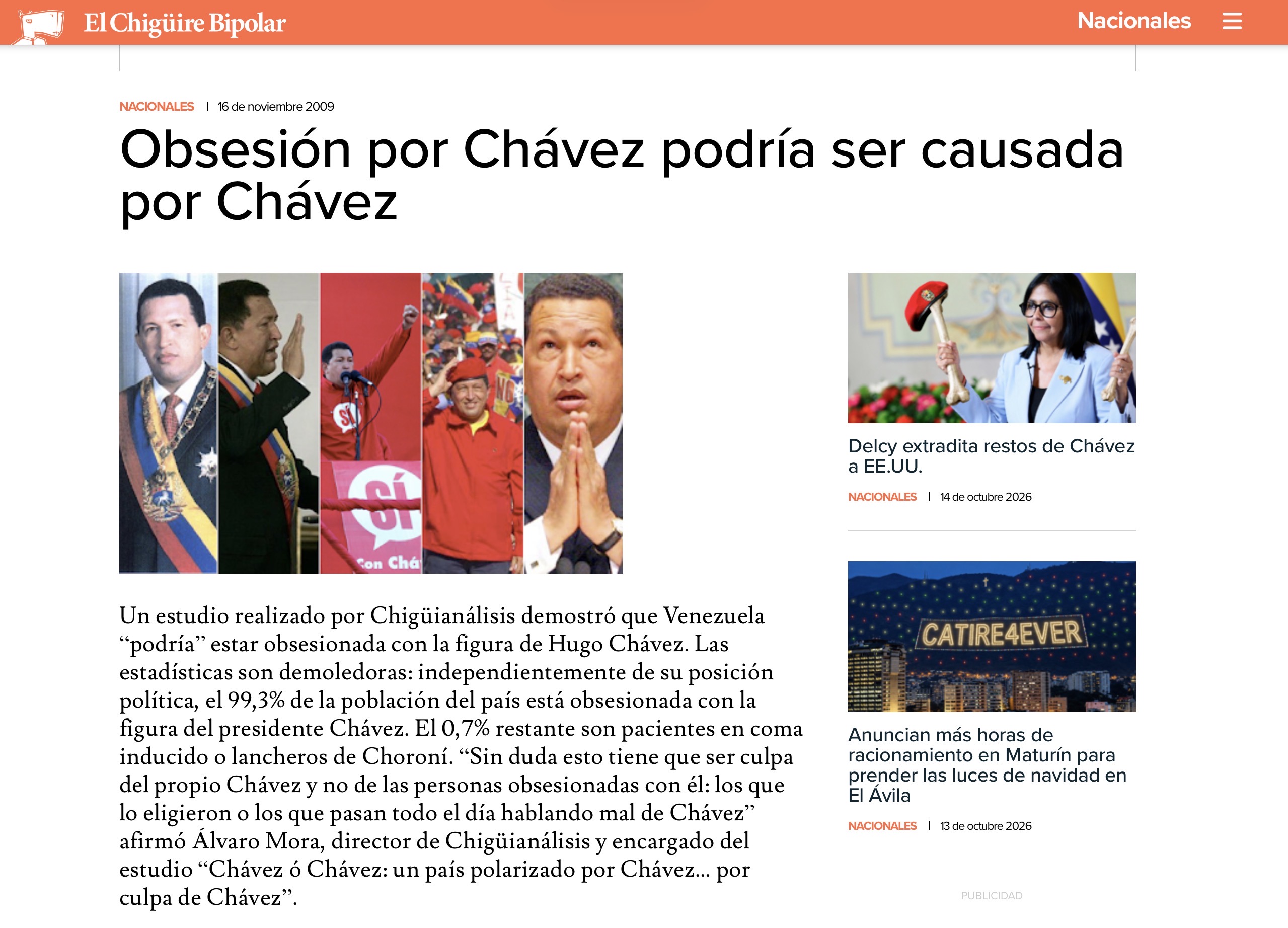
However, that dominance would not last. After accounting for roughly 45 percent of content during the outlet’s early years, parody accounted for less than 10 percent of output in the early 2020s. Parody fell in two stages: first between 2010 and 2012 and again after 2018.
Yet, as parody declined, exaggeration took its place. Instead of reproducing official discourse and exposing its contradictions, El Chigüire increasingly processed political reality through exaggerated scenarios, impossible premises, and deliberately and directly mocking figures in Venezuelan society. The change did not happen overnight, but one of the clearest breaks in the data appears around 2017. Then, you could see articles like Aquí iba un titular pero la Guardia Nacional lo robó (“There Was a Headline Here But a National Guard Stole It”), showing, with a rather meta scenario, the emerging tension with authorities as the country was entering into a period of mass protests.

“Our perception was that people were having such a hard time that they didn’t need anyone reminding them of it.”
Moreover, in the eighteen months surrounding that year’s protests and Constituent Assembly election, irony fell from 30.3 percent of El Chigüire’s content to 19.6 percent, while exaggeration rose from 14.3 percent to 22.9 percent. By the early 2020s, exaggeration had become El Chigüire’s dominant form of satire. In the eighteen months leading up to the 2024 presidential election, it accounted for 46.4 percent of the outlet’s classified articles. Then, articles like Ministerio Público emite orden de aprehensión contra chamo que planeaba salir sin su chemise del PSUV (“Prosecutor General’s Office Issues Arrest Warrant Against Guy Who Planned to Leave Without His PSUV Shirt”) showed the intensification of repression.
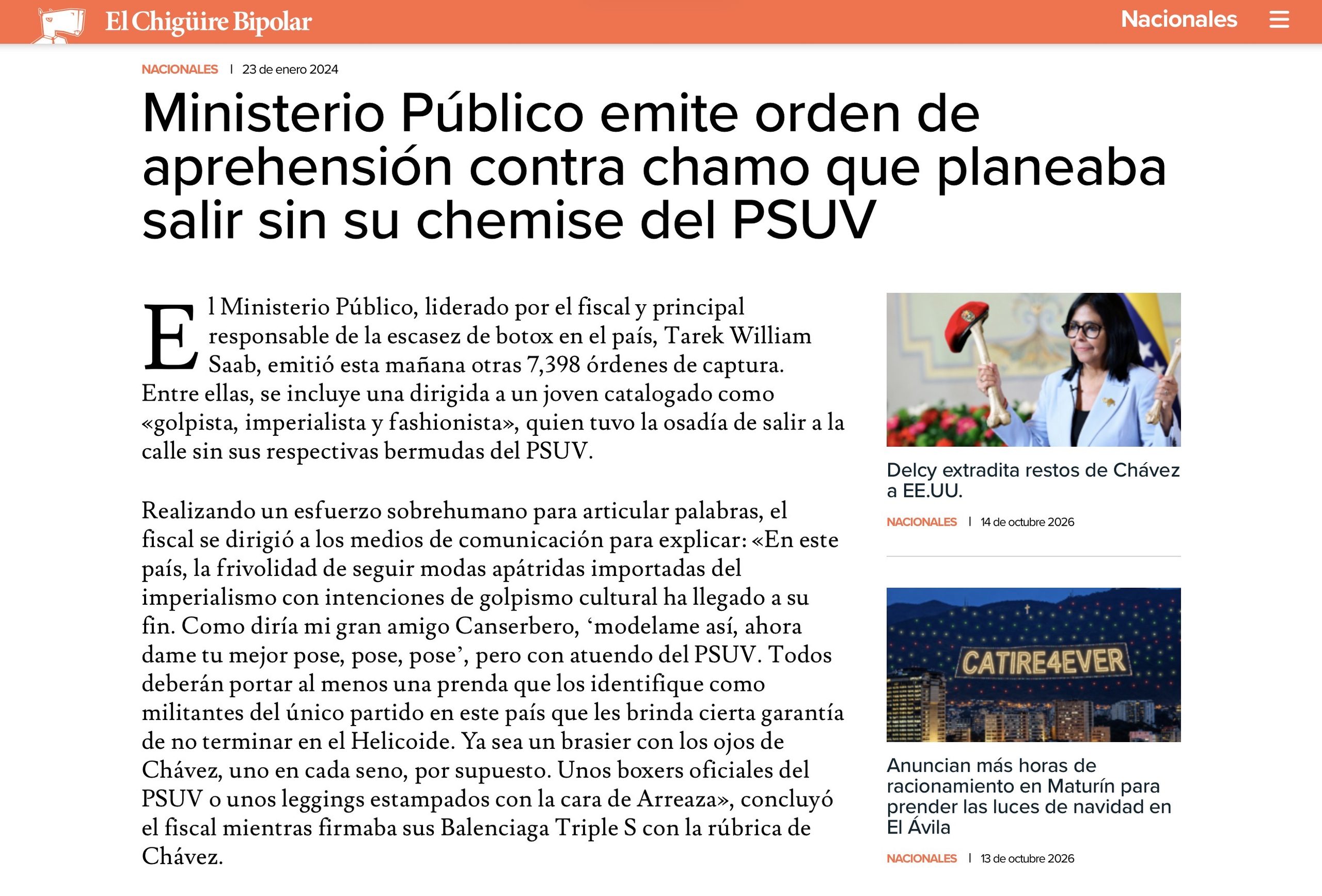
The data partly supported my hypothesis. Satire did change as conditions worsened, but the shift pointed less to a fear of consequences than to another transformation that I couldn’t see in the archive: a change in the audience.
Reality bites
Elio Casale, a long-time writer of El Chigüire and one of its founding members, explained that, during the 2017 crisis, posts about politics were not performing as well as others related to entertainment or sports. Therefore, political content became less prevalent on the site: “Our perception was that people were having such a hard time that they didn’t need anyone reminding them of it. And it didn’t take particularly keen insight to realize that. Things were so bad that year that we ourselves, the writers, all of us, were in a pretty dark place,” Casale said. Some examples of this non-political content included articles that mocked everyday life, like the piece Señor de 37 años sigue considerándose «un chamo» (“A 37-Year-Old Man Still Considers Himself a Chamo”).

Casale also mentioned that the transformation happened organically: “At first we were perplexed. It even started to worry us, because when you see content that is well-structured and well-written receive such a cold response, you start thinking things like ‘maybe we’ve lost our touch.’ But we realized that this was happening exclusively with political content. Then, through intuition and trial and error, which is how we’ve learned so many things since we started, we changed the mix,” he added.
This doesn’t mean that political content was absent. Casale emphasizes that political humor was one of El Chigüire’s reasons for being. Just that it was not as frequent: “Later, when politics became more active again, political content regained a larger share of what we published on the site. This is a cycle that has repeated itself on other occasions, but 2017 was the first time we were able to see it happening.”
Political humor is a relationship between reality, the person making the joke and the audience expected to laugh at it. In Venezuela, all three were changing drastically at the same time.
Casale was describing topics, while my model measures technique, but the two are linked. Parody depends on a target to imitate, such as a government official, a press release or a repeating format. When political content shrank, there was less official language to borrow, and the jokes that remained leaned on invented scenarios instead.
Casale’s explanation complicated the story I expected to find. I began the research primarily interested in political risk and how a repressive environment might change the way satirists wrote about those in power. Yet the archive and the people who produce it point to something bigger: political humor is a relationship between reality, the person making the joke and the audience expected to laugh at it. In Venezuela, all three were changing drastically at the same time.
That makes El Chigüire’s archive quite useful for understanding something conventional political indicators struggle to capture. Elections can tell us how people vote. Economic indicators can tell us how their material conditions are changing. Migration figures can tell us how many have left. But none of them can tell us what Venezuelans find absurd, what they have become exhausted by, or what they are ready to laugh about again. Eighteen years of jokes cannot explain Venezuela, but they preserve a small record of how Venezuelans have processed a country that keeps changing around them.
Now, as the country continues through yet another period of rapid political change, what Venezuelans laugh about, and how they laugh about it, may tell us something about the country that emerges on the other side.