
Photographs by Ana Cristina Febres Cordero. Read the Spanish-language version of this story on Runrunes and Historias Que Laten.
“María Corina is here! María Corina is here!” two women shout in unison from a balcony in Colinas de Bello Monte, a middle-class neighborhood in eastern Caracas. One of them waves a Venezuelan flag. It’s 11:50 am on a sunny Sunday, October 25, with the Ávila mountain standing clear against the sky.
A few minutes later, cars coming from Las Mercedes honk their horns incessantly, an impromptu celebration impossible to ignore. A red traffic light brings the line of vehicles to a halt and a woman steps out of the lead car to cry out:
“María Corina has returned!”
In the Colinas de Bello Monte Linear Park—a new public space featuring a walking path and a bike lane along the banks of the Guaire River—a group of runners witness the scene and stop. “What’s happening?” they wonder. Gradually, several people out for their Sunday exercise gather under a tree. A cyclist joins the circle, acting as a town crier, and delivers the news. “María Corina is in Venezuela, she’s arrived”, he says, and shows on his phone Machado’s post on X: “I am here, with you”. The people applaud and express their gratitude for the news.
In a packed café in Las Mercedes, just past two in the afternoon, a waiter switches the channel from an important football match on ESPN to a YouTube broadcast of NTN24 with the headline: “First photos of María Corina emerge following her arrival.”
“She’s at the sanctuary of the Divina Pastora in Santa Rosa. She’s in Barquisimeto, she arrived via Lara state,” the waiter explains to his colleagues working the café’s register. Meanwhile, footage of the Nobel Peace Prize laureate captures the full attention of everyone in the café, most of whom are now searching for further updates on their own mobile phones.
As one travels across the city from west to east, it becomes clear that the news has spread like wildfire. It is four o’clock in the afternoon at Plaza Sucre in Catia, a former chavista stronghold, where a group of supporters from the Vente Venezuela party have gathered, holding small banners that read Vente Catia. “María Corina is already on her way here.” “She’s coming via the Regional del Centro highway and will reach Caracas by way of the Valle-Coche expressway. We’re waiting for some colleagues, and from here, we’ll all head over there to welcome her,” explains 58-year-old María José Pérez, a resident of La Silsa.
About half an hour later, near Plaza La Candelaria, a similar scene unfolds. Just a few steps from the massive statue of Saint José Gregorio Hernández—unveiled in the square following his canonization in 2025—and facing the façade of the La Candelaria Church (still undergoing repairs for damage sustained in an earthquake), about 50 members of Machado’s party have gathered. “May our Saint bless Venezuela. Today is a day when we reclaim our hope,” says 29-year-old Carlos Prieto. “I’m not a party member, but I have friends here, and, of course, I’m joining in to celebrate María Corina’s arrival. We’ve been waiting for her. She is the legitimate leader,” he adds.
Around the obelisk in Plaza Altamira, in eastern Caracas, the atmosphere at 5:15 pm is like a festival. Dozens of people—carrying whistles, Venezuelan flags, banners, and even drums—are celebrating. Vehicle traffic on Avenida San Juan Bosco is moving slowly due to the crowds gathered on both sides of the road; however, drivers are also joining the celebration by honking their horns in support. Using a megaphone, Miguel Ángel Ortiz, a 79-year-old man wearing a Tiburones de La Guaira jersey, updates everyone on the progress of the opposition leader’s journey toward Caracas. “She left Lara, has already passed through Yaracuy, and has arrived in Carabobo. She’ll be stopping at the Guacara and Palo Negro toll plazas, near Maracay. From there, she’s heading to Caracas. She’ll enter via the Valle-Coche highway, and the welcome point is in Santa Mónica. Everyone to the highway! The one we’ve been waiting for has arrived!”
“We had faith that she would come in to defend the rights of all Venezuelans. No one can stop this change,” says Rina Palma, who came from the close city of Los Teques to reach Altamira.
As night falls over Caracas—from 7:00 pm onward—caravans of vehicles and motorcycles, their horns blaring, grow more frequent everywhere. Meanwhile, the sound of pot-banging echoes from balconies and terraces, and expressions of joy—such as people dancing in the streets—can be seen across various parts of the city: La Redoma de Petare, El Marqués, Los Dos Caminos, La Carlota, Los Ruices, and Chacao.
From the Plaza Venezuela Metro station, a steady stream of people can be seen heading toward the stadium area within the Ciudad Universitaria. Others are making their way from the Los Símbolos Metro station (Line 3) in Los Chaguaramos. Everyone is headed for the highway. On the Los Próceres side, vehicle access has come to a standstill, and the Santa Mónica interchange has effectively turned into a parking lot. A massive throng of people is also making its way on foot from Valle Abajo, climbing up from the San Pedro Temple to reach the bridge that leads to the Valle-Coche highway. Another procession arrives from the La Bandera interchange. It is a river of people.
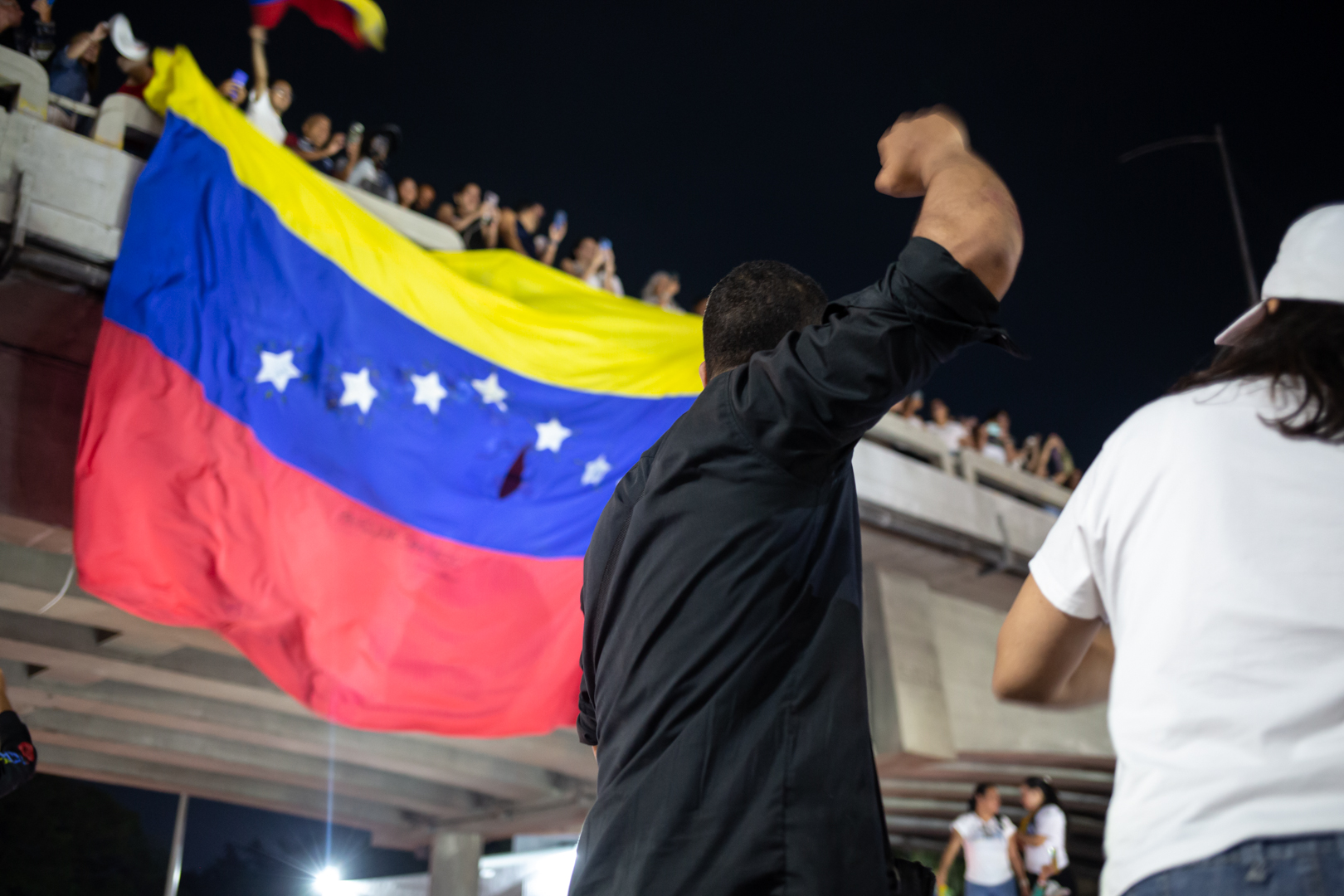
On the highway, the lanes in both directions are packed. The main land gateway into the Venezuelan capital from the country’s central-western region has come to a complete standstill. By eight o’clock in the evening, there isn’t an inch of space left. The people have taken to the streets—a sight not seen in Caracas for a very long time.
“The fear is gone. Venezuela needs to be free,” says 32-year-old Orlando Sanoja, who traveled from Guarenas with his wife and their three children.
“The people want change. And here they are. I came from La Guaira—I’m a survivor of the earthquakes. I came because I want a better country for my children; they deserve it,” asserts 47-year-old Josefina Suárez Rondón, a resident of Catia La Mar.
A line of vegetable trucks pushes its way through the crowd in the lane coming from Coche. These are produce vendors from La Grita, in Táchira state, arriving on Sunday night with a cargo of potatoes, onions, carrots, tomatoes, celery, and other vegetables to stock the markets for the people of Caracas starting Monday. Perched atop sacks of potatoes on one of the trucks, a vendor calls out to the crowd: “She’s here, she’s here, she’s here… María Corina is heeeere!” “She’s here, she’s here, she’s here… She’s heeeere!” It is a collective chant that echoes across the highway.
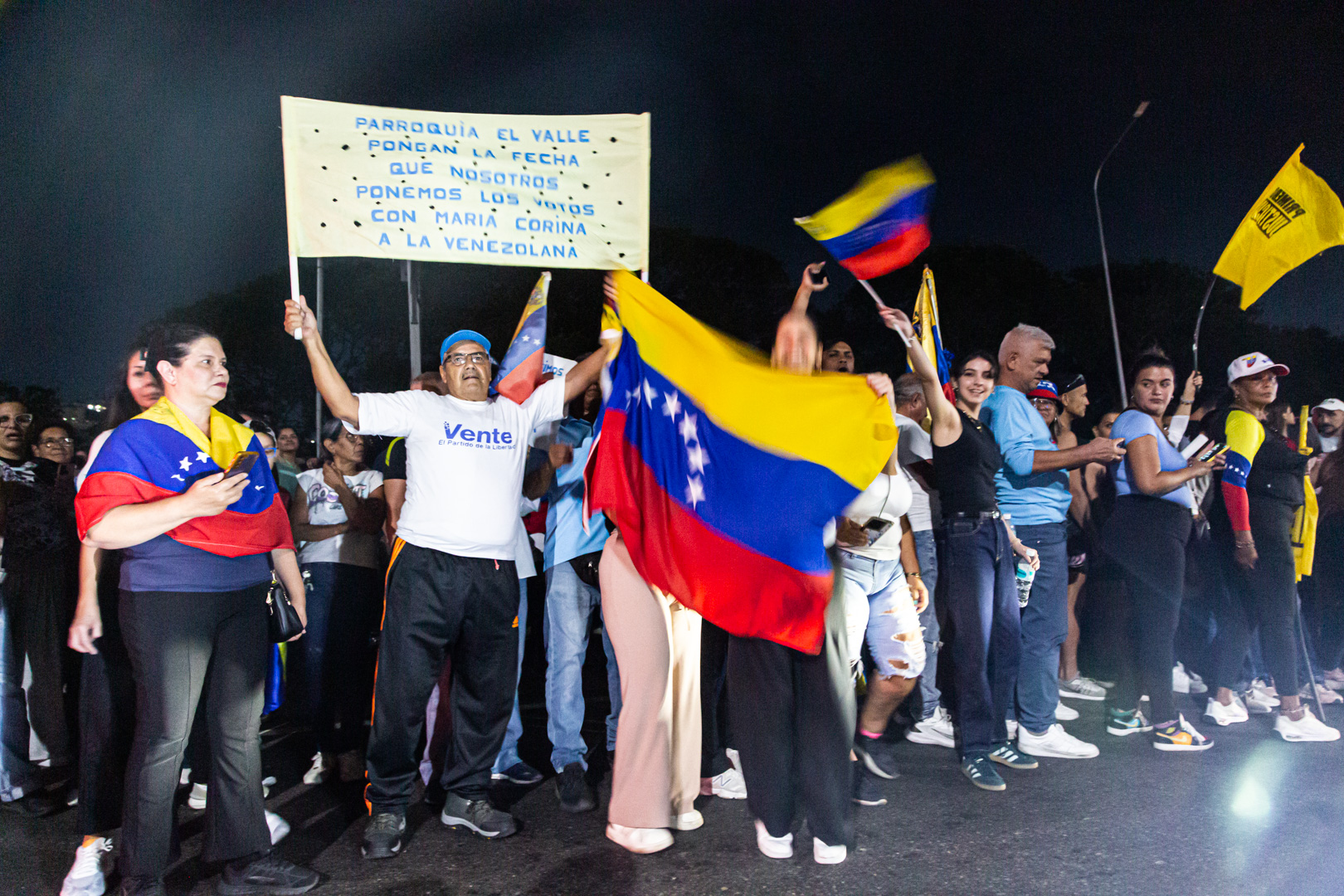
There are thousands upon thousands of people, carrying flags of all sizes and placards. “Freedom, freedom, freedom! Free elections now!” and “The people want change! Venezuela wants change!” can be heard repeatedly. The signs are clearly legible: “Delcy, no one elected you.” “Respect Venezuela.” “United States, thank you for the ‘3E’ [January 3, the day of the militart intervention that toppled Maduro], but the oil is ours.” “Rodrigato, get lost!”
It is past 10:00 pm, and anticipation for the imminent arrival of María Corina Machado in Caracas continues to mount. The highway is packed to capacity; there is no room for another soul. Word spreads that the opposition leader has reached the Tazón toll plaza. The excitement is immense, as is the traffic jam. The only way to get through is by motorcycle or… on foot. Hundreds of residents from these working-class neighborhoods come out to welcome the political leader in front of the Fuerte Tiuna military complex, a bottleneck that slows the caravan down by at least an hour due to the sheer number of people.
It is 11:45 pm when María Corina Machado finally reaches the Santa Mónica interchange, the designated arrival point in Caracas where the largest crowd is waiting for her. She appears before the people, standing on the open roof of a 4×4 vehicle, surrounded by motorcycles. She is dressed in blue jeans and a long-sleeved white T-shirt, with numerous rosaries—adorned with crucifixes and images of the Virgin Mary—hanging around her neck. Although she does not step down, the vehicle comes to a halt at the heart of the gathering. She greets everyone who approaches.
“Long live Venezuela! Long live a free Venezuela!” the crowd chants.
“Bring back my children who emigrated!” a mother calls out, managing to shake her hand and gift her a rosary. “We will bring them back!” María Corina shouts in response, leaning over the roof of the vehicle. Meanwhile, fireworks are set off from the high-rise buildings in Valle Abajo, illuminating the crowd below and revealing several drones with cameras capturing the scene from above.
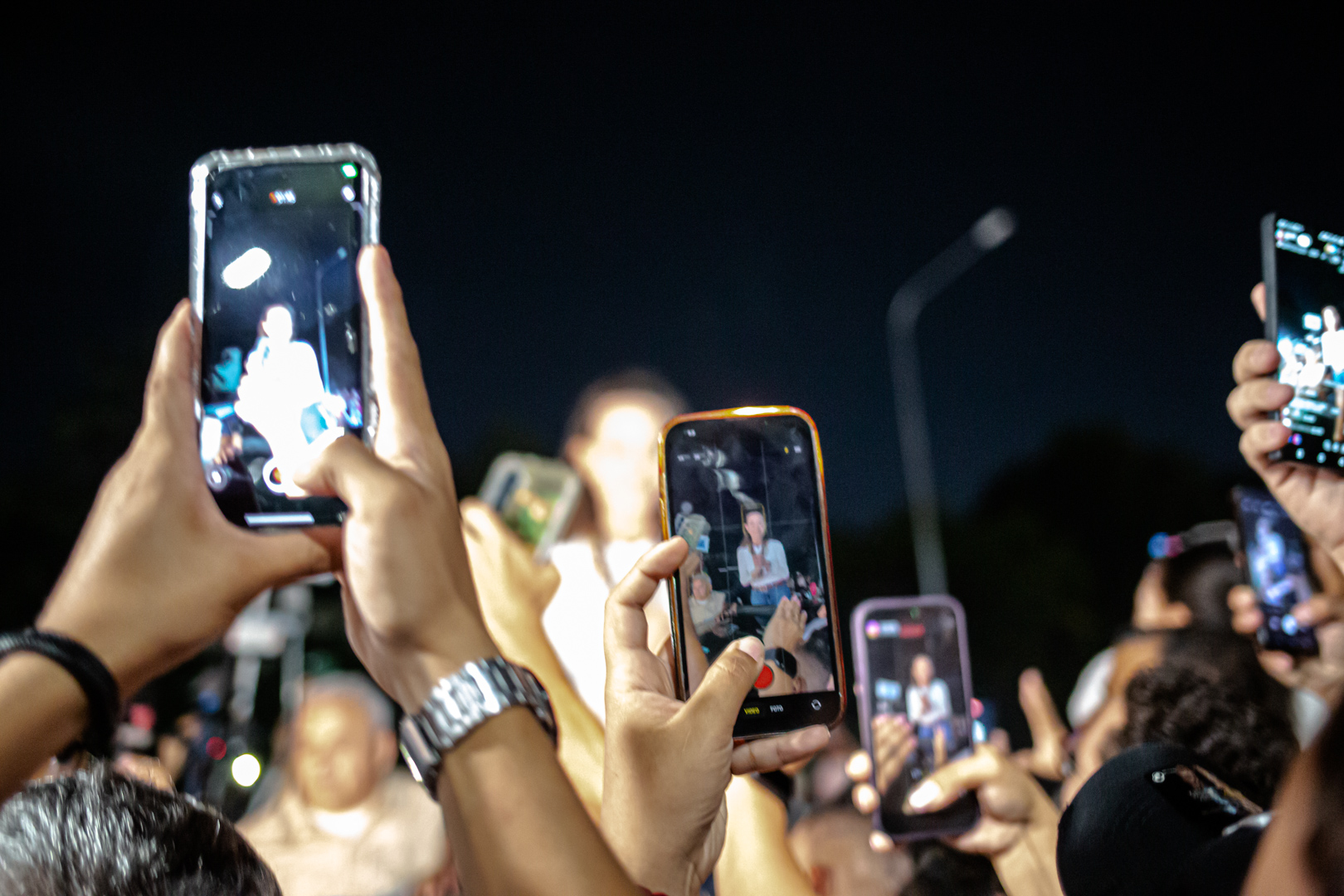
“Isn’t she going to give a speech?” a man asks.
“She doesn’t need to speak. The people have already spoken,” replies a woman wearing a Vinotinto (national football team) jersey that reads: “Fortitude—God’s timing is perfect.”